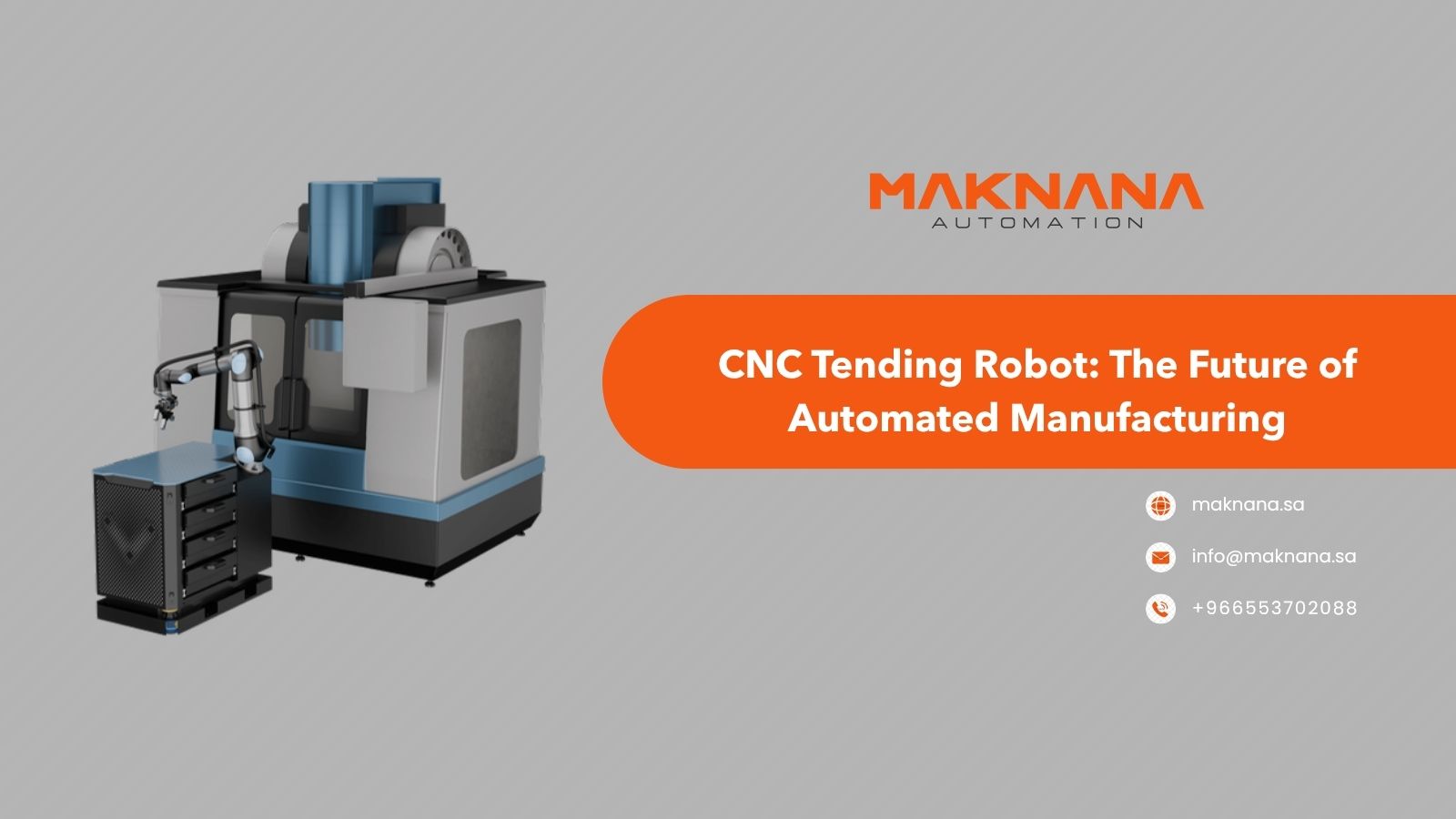
CNC Tending Robot: The Future of Automated Manufacturing
July 7, 2026
Modern manufacturing plants are turning to the cnc tending robot as a way to keep production lines running around the clock, since it removes the burden of repetitive loading and unloading from human operators, and it gives factories the flexibility needed to handle both small batches and large production runs, while also reducing the operating costs that come with manual labor over time, and as global demand for industrial automation keeps rising, this solution is becoming a strategic choice for any factory aiming to stay competitive in its market.
What is a CNC tending robot?
A cnc tending robot is a programmable robotic arm that loads raw material into a machine and unloads the finished part once the cycle ends, and it works in direct coordination with the machine controller, replacing manual intervention in repetitive tasks while keeping every cycle consistent.
The core elements that make up this type of automation can be summed up as follows:
- A multi-axis robotic arm capable of handling parts of different shapes and sizes
- Vision systems and sensors that locate and confirm the position of a part before loading
- Control software that allows a quick changeover between different production batches
- A simple operating interface that lets technicians reprogram the cell without deep robotics expertise
Factories running multiple product lines increasingly rely on this kind of automation as a practical entry point into smart manufacturing, so if your plant is exploring where to start, reaching out to a specialized team can save considerable time in choosing the right system for your line.
Key functions of CNC tending robot:
This category of systems performs several tasks on the shop floor, starting with part loading and extending to real-time quality monitoring, which makes it a core piece of any broader digital transformation plan for a factory.
The main functions this equipment carries out can be organized as shown below:
- Loading raw parts and unloading finished products in sync with the machine cycle
- Carrying out repetitive cnc machine tending tasks without requiring constant supervision
- Inspecting part quality through built-in cameras before moving pieces to the next stage
- Coordinating material flow between different workstations along the production line
Once these functions are combined into one automated setup, a facility gains a smoother production line that is far less prone to sudden stoppages, so to get the most out of these capabilities it is worth reviewing your line's exact requirements with a specialist before making a purchase decision.
Explore: The Best CNC Company in Saudi Arabia for Industrial Solutions
Types and benefits of CNC tending robots:
Available systems on the market differ in size, payload, and mounting method, and specialized suppliers now offer several forms of cnc robots designed to match the requirements of each individual factory, allowing the most suitable option to be chosen based on the parts being produced.
The main types and their associated benefits can be classified as follows:
- Six-axis articulated arms, suited to heavy and irregularly shaped parts
- Lightweight collaborative units, which work safely beside operators in the same space
- Cartesian systems, offering precise linear motion when handling regularly shaped parts
- High-speed SCARA units, suited to fast assembly and sorting operations
Independent market research indicates that the global segment for these robotic tending systems is valued at roughly 1.4 billion US dollars in 2026 and is projected to reach about 2.3 billion US dollars by 2033, growing at a compound annual rate of around 7.3 percent, driven largely by rising labor costs and the growing need for consistent production quality, and this reflects manufacturers' increasing confidence in this category of solutions, so if your factory is planning to scale up, choosing the right type from the outset can save on costly adjustments later.
How does cnc tending robot maximize productivity?
A cnc tending robot keeps machines running for far longer stretches without the breaks a human operator would need, which translates directly into higher daily output, while also cutting down on the unplanned downtime that often comes from fatigue or manual handling errors.
The way this equipment lifts overall efficiency can be seen in the following points:
- Continuous round-the-clock operation that shortens downtime between production batches
- Consistent part quality resulting from precisely repeated motion on every cycle
- Fewer incidents linked to manually handling heavy or sharp components
- Freeing technicians to focus on supervision and preventive maintenance instead of repetitive loading
A recent analysis of the collaborative robot segment confirms that rising labor shortages and operational costs are pushing more manufacturers toward this kind of automation, with the market for collaborative robots projected to grow at a compound annual rate of over 23 percent through 2033, which opens the door for a cnc tending robot to be applied on facilities of many different sizes, and to see the real impact this kind of automation could have on your line, you can request an initial assessment from a specialized engineering team.
Explore: CNC Machine Maintenance Companies in Saudi Arabia
The future of industrial automation in Saudi Arabia:
Saudi Arabia is moving steadily toward wider industrial automation under Vision 2030, as localization programs and the need to reduce reliance on expatriate labor push more factories across multiple sectors to install a cnc tending robot on their lines.
The main drivers behind this shift in the local market can be summarized below:
- National industrial development programs that actively encourage smart manufacturing adoption
- Growing domestic automotive production, which raises demand for automated welding and assembly
- Harsh climate conditions that make automated operation a more efficient choice than manual work at certain sites
- Public and private investment flowing into advanced industrial hubs across major cities
Global data from the International Federation of Robotics shows just how wide this gap still is, since South Korea leads the world with roughly 1,220 robots per 10,000 manufacturing employees, while Singapore and Germany follow with 818 and 449 units respectively, and against that benchmark, Saudi Arabia's manufacturing base still has considerable room to grow, so as this momentum continues, planning for a cnc tending robot early is turning into a clear competitive edge for ambitious factories in the Saudi market.
Contact With Leading CNC Machine Suppliers in Saudi Arabia
Maknana: Solutions for robotic machining & machine tending
Maknana delivers complete machine tending robot solutions that cover a factory's needs from installation through operation and maintenance, ensuring a smooth shift toward fully automated lines without disrupting existing operations.
The main advantages of working with a specialized team in this field are outlined below:
- Studying the current production line to identify the best points for integrating a robot
- Selecting the right arm and end-of-arm tooling based on part type and production volume
- Programming and calibrating the system to match the factory's quality standards
- Providing ongoing technical support and scheduled maintenance to keep operations running without interruption
If you are looking for a partner that understands your factory's needs and can design a solution built specifically for your line, reaching out to the Maknana team gets you an initial consultation that lays out the practical implementation steps and expected cost before you make any final decision.
